
MAKE PLANNING GREAT AGAIN
Article 4
Why the DA system cannot reform itself, and what it will take to change that.
The DA system is not broken. That is the first thing to understand, and the hardest. A broken system fails to deliver what it was designed to produce. The NSW development assessment system delivers, with remarkable consistency, exactly what it was designed to produce. The problem is that what it was designed to produce is not housing, or planning outcomes, or a functional relationship between development and the communities it is supposed to serve.
What it produces is a distribution. Power flows to State agencies. Revenue flows to councils. Professional identity flows to practitioners. Political accountability structures are arranged so that every tier of the system can deflect blame downward when outcomes disappoint. A system that delivers all of that to all of its incumbents simultaneously is not a failed system. It is a remarkably successful one.
Reform fails not because reformers lack good ideas. It fails because every serious proposal threatens the distribution. The State loses override leverage. Council loses fee revenue and local political control. The profession loses the mystique that comes from being the gatekeeper of a complex discretionary process. Nobody in that stack has a clean incentive to fix the thing they depend on. So the thing does not get fixed.
This is not a planning problem. It is a political economy problem. And political economy problems do not get solved by better policy. They get solved by pressure from outside the system that makes the status quo more costly than the alternative.
What the System Actually Produces
Let’s start with the State. State government agencies hold the instruments that define what development is permissible, where, and on what terms. SEPPs can override LEPs. The Minister can call in applications. Division 4.3A, inserted by the Planning System Reforms Act 2025, allows a SEPP to declare development as Targeted Assessment Development, stripping the consent authority of the ability to consider site suitability, environmental impact, and the public interest under s.4.15(1)(b), (c) and (e). Is that streamlining? I’d argue it is a power transfer dressed as efficiency. The State retains the ability to pre-resolve the questions that matter while handing councils the procedural residue.
Council holds something different and in some ways more durable: the revenue stream and the local political legitimacy that comes from being the consent authority. Development application fees, while nominally set at cost recovery, have become structurally embedded in council budgets. More importantly, the DA function gives elected councillors a direct line into individual development decisions that no State government reform has yet been willing to fully extinguish. The call-in power works both ways. The State can take decisions away from council. But the political cost of doing so routinely is high enough that council retains meaningful territory.
The planning profession holds professional identity and the revenue model that flows from it. A complex, discretionary, instrument-dense assessment system requires expert navigators. Town planners, engineers, heritage advisors, bushfire practitioners, ecologists: all of them derive their commercial position from the gap between what the instruments require and what an applicant can self-administer. A fully legible, self-administrable system would eliminate that gap. Nobody in the profession is building a business case for making themselves redundant.
Political accountability sits across all of this as a kind of load-bearing fog. When a DA is refused and the applicant is aggrieved, the planner points to the instrument. The council points to the State. The State points to the community. When a DA is approved and the neighbour is aggrieved, the triangulation collapses. The neighbour does not blame the instrument. They do not blame the State agency that wrote the SEPP. They blame the council. Council wears the community anger for decisions that were substantially pre-determined by instruments they did not write and cannot override. That asymmetry is load-bearing. It is why councils are institutionally motivated toward refusal and delay. Not incompetence. Rational self-protection against blame they cannot avoid. Which is no accident. It is the system operating as designed.
Why Every Reform Attempt Fails at the Same Point
NSW has been reforming its planning system continuously since the EP&A Act was enacted in 1979. The White Paper of 2013. The rewrite that never happened. The Low Rise Housing Diversity Code. The Housing SEPP. The Planning System Reforms Act 2025. Each round of reform is announced with the same language: streamline, simplify, accelerate, deliver housing. Each round leaves the underlying distribution of power, revenue, and professional identity substantially intact.
The pattern is consistent enough to be diagnostic. Reform that touches process, the portal, the timeframes, the checklist, the lodgement requirements, passes. Reform that touches distribution, who makes the decision, who gets paid, who bears professional accountability, gets modified, delayed, or absorbed into the existing architecture until it no longer threatens anyone who matters.
The reforms that do not pass have a consistent profile. Mandatory cost-recovery pricing for DA assessment. Binding pre-lodgement positions. Professional accountability for assessment officers. State liability for defective instrument drafting. Independent audit of determination patterns. Each of these would shift the distribution in ways that matter. Each has been raised, considered, and quietly set aside. The State will not compel councils to price DAs at full cost because it would make the political cost of the assessment system visible to applicants in a way that current cross-subsidisation obscures. It will not create professional accountability for assessment officers because that accountability would eventually reach the instrument-writers above them. These are not oversights. They are decisions.
The complying development expansion is instructive. Shifting genuinely code-assessable residential work into the CDC pathway was the right call. It removed work from the assessment station that did not require merit judgement and gave it to private certifiers who could process it efficiently. But it was designed with a boundary condition that ensured the DA system retained everything above the compliance threshold. That boundary condition was not drawn at the point where merit judgement adds genuine value. It was drawn at the point where the profession and the councils were willing to let go.
The 2025 reforms follow the same arc. The insertion of the word ‘significant’ before ‘likely impacts’ in s.4.15(1)(b) is framed as a materiality threshold that will reduce assessment burden. The guidance note published by DPHI to explain the reform acknowledges that in the absence of any legislative definition, the interpretation of ‘significant’ may evolve over time as the courts consider its application. A reform designed to reduce litigation uncertainty will generate years of litigation to define its own terms. The Fordist impulse to standardise the input produces a new round of uncertainty at the output.
The Code Assessment Problem: Fordism Without a Factory
The State’s sustained push toward code-based assessment is the clearest expression of the political economy problem. On paper it looks like rationalisation. In practice it is the State attempting to capture more of the distribution for itself by removing council discretion, while retaining the appearance of a local assessment system.
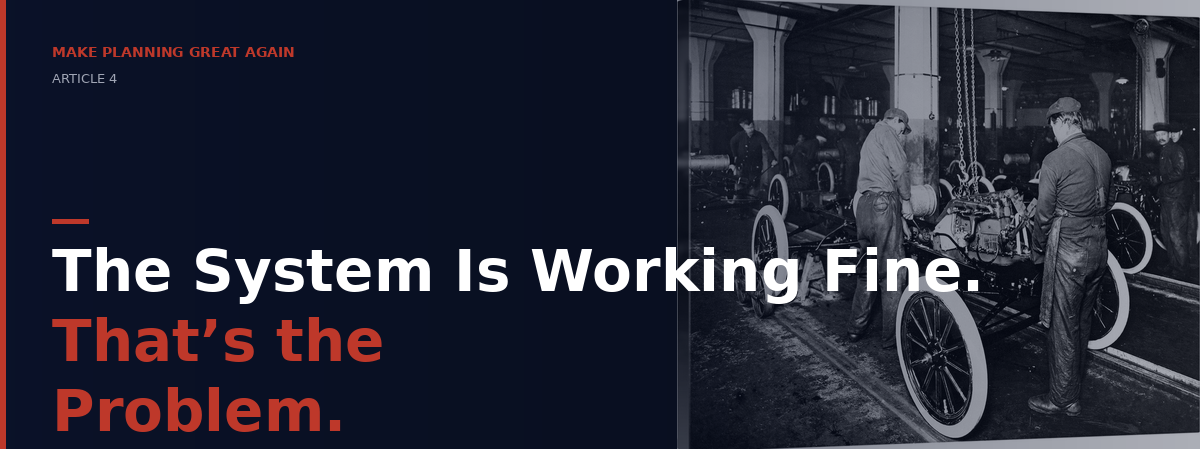
The Fordist production line of 1913 worked because every input was standardised, every tolerance was known, and every workstation processed one discrete task with no dependency on the judgement of the workstation before it. The code model attempting to import that efficient logic does so into a context where the inputs are not standardised, the tolerances interact nonlinearly, and the relevant variables cannot be fully specified in advance.
Bushfire prone land cannot be meaningfully code-assessed because the BAL outcome is a function of site-specific vegetation, slope, aspect, and defendable space geometry that varies at fine spatial resolution. You can write a code specifying BAL-40 as the maximum acceptable level. You cannot write a code that pre-resolves whether a specific configuration of retained vegetation on a specific slope at a specific aspect produces BAL-40 or BAL-FZ. The code sets the standard. It cannot substitute for the judgement.
Ecology compounds this. The Biodiversity Conservation Act regime requires site-specific survey data, species distribution modelling, and impact prediction that is inherently site-contingent. A code that pre-resolved ecological impact would need to operate at a spatial and temporal resolution that makes it indistinguishable from a site assessment. At that point the code is not a code. It is an assessment wearing a code’s clothes.
The conflict between bushfire and ecology is the cleanest example of what the code model cannot resolve. The BAL assessment drives toward vegetation management. The biodiversity assessment drives toward vegetation retention. Both are technically correct within their own regulatory framework. The code has no mechanism for resolving that conflict because the conflict is a policy contradiction that was never resolved at the instrument level. It was delegated downward to the assessment stage and dressed up as a technical problem awaiting a technical solution. The DA planner absorbs the cost of that reframing. The applicant pays for it. The system calls it process.
The same dynamic runs through engineering and ecology. Stormwater management requires impervious surfaces, detention capacity, and defined discharge points. Ecological assessment of the receiving environment may find that the pre-development hydrological regime is critical habitat condition for a listed species that cannot absorb the altered flow regime. Both the engineer and the ecologist are right. Satisfying one constraint moves the design outside the feasible region for the other. No code resolves a simultaneous constraint problem. It can only declare it someone else’s problem.
Nobody writes a code that makes themselves redundant. The instruments are incomplete by design, not by oversight. The discretionary layer above the code exists because the code was written to need it.
The Political Economy Diagnosis
Name it plainly. The people with the power to redesign the system are the same people whose position depends on the existing design. That isn’t a conflict of interest that can be managed by better governance. It is structural. It will not resolve from within.
The State can write instruments that look like reform while preserving the override capacity that matters to it. It has done this repeatedly. Council can absorb process changes while retaining the revenue base and political function that matter to it. The profession can adapt its service offering to each new regulatory configuration while continuing to derive value from complexity. Each actor is rational. Each actor is optimising for their own position within the existing distribution. The system reproduces its own dysfunction and calls it incrementalism.
The thirty-year reform record confirms the pattern. Strategic planning capacity has been shifted upward to the State. Complying development has grown. Panel determination thresholds have been adjusted. The portal exists. None of it has materially changed who holds power, who earns revenue, who bears professional accountability, or who can deflect blame when outcomes disappoint. The distribution is remarkably stable across a generation of reform effort.
This is what a political economy problem looks like. Not a failure of good intentions. Not a shortage of reform proposals. A structural alignment of incumbent interests around a distribution that reform would threaten, operating through institutions with the capacity to absorb and neutralise reform attempts before they reach the distribution.
What Changes Political Economy Problems
Not better policy. External pressure that makes the status quo more costly than the alternative.
The housing crisis is the most visible pressure point. When housing unaffordability becomes a first-order electoral problem, the political cost of defending the existing distribution starts to approach the political cost of reforming it. That threshold has not been crossed in NSW. But it is closer than it has ever been. The State government that can credibly blame the planning system for housing costs, and demonstrate that it has genuinely transferred power rather than reshuffled it, holds a significant electoral asset. The calculation is shifting.
The productivity argument is the second lever. Treasury and infrastructure agencies are increasingly willing to frame planning delay as an economic cost with a measurable dollar value. That reframes the conversation from a planning debate to a fiscal one. It brings different institutional actors into the room with different leverage and different institutional interests. When the Productivity Commission or Infrastructure Australia assigns a cost to assessment timeframes, the defence of the existing system requires an argument about economic value that the system has never been asked to make.
The professional legitimacy question is the third and least developed pressure. If the planning profession cannot demonstrate that discretionary merit assessment produces outcomes that code-based assessment cannot, the argument for preserving the discretionary layer weakens. The profession has not made that case coherently because making it requires admitting that a significant proportion of current DA work does not require professional merit judgement. That admission is institutionally threatening. But the alternative, continuing to claim the value of professional discretion while the system produces the outcomes it currently produces, is becoming harder to sustain publicly.
The pressure points are building independently. What they have not yet done is converge into a single moment that makes the status quo untenable for all incumbents simultaneously. That convergence is what precedes genuine reform of a political economy problem. It is not manufactured by better policy arguments. It arrives when the cost of not changing exceeds the cost of changing for enough actors at the same time.
What Making Planning Great Again Actually Requires
Not a reform proposal. A reorientation.
The question is not how to make the existing system work better. It is what a system designed around outcomes rather than distributions would actually look like, and whether anyone with power has the appetite to build it.
A system designed around outcomes would separate the development that genuinely requires professional merit judgement from the development that requires only competent compliance assessment, and build different institutions for each. The compliance pathway needs rigour, accountability, and self-administrability. The merit pathway needs professional credentialing with real consequences, a resolution framework for competing disciplinary standards that operates at the instrument level rather than being delegated to the assessment stage, and a consent authority model resourced and credentialed to exercise the judgement the task actually requires.
It would require the State to bear the cost of bad instrument drafting rather than exporting that cost to applicants and consent authorities. It would require the profession to define what merit assessment actually delivers and to stand behind that definition with professional accountability. It would require councils to price DA work at actual cost and to be honest about which development categories they have the capacity to assess competently.
None of that is technically difficult. Planning practitioners know what it looks like. The difficulty is entirely political. Every element of the reorientation threatens part of the existing distribution. The State loses instruments it uses as political levers. Council loses revenue cross-subsidies and political functions. The profession loses value derived from complexity rather than competence.
The runway gets built. The lodgement checklist is completed. The referral letters go out. The assessment report is written. The determination issues. And the thing that was supposed to happen, a well-designed, appropriately assessed, community-serving built environment, does not reliably appear. The ritual is performed. The outcome is not produced.
That is the cargo cult. And cargo cults do not end because their participants recognise the error. They end because the cost of maintaining the ritual eventually exceeds the returns it delivers, and something outside the ritual makes that visible.
That moment is coming. The question is whether the profession is ready to be part of what comes after it, or whether it will still be standing on the runway when it does.
This is Article 4 in the MPGA (Make Planning Great Again) series.
Article 1: Delete the Council DA Planner.
Article 2: The Registered Planner Certified Assessment Model.
Article 3: Nimbin, Co-Living and Cooperative Housing: 50 Years of ignoring council and getting on with it
Simon Halcrow is a Registered Planner and Registered Environmental Assessment Practitioner and Development Manager at Design Build Instruct Pty Ltd (DBI). He works across Development Applications, Planning Proposals, State Significant Development and State Significant Infrastructure in NSW. Visit www.dbilink.com.
References
Gadens. (2026, February 19). NSW planning system reforms: What developers need to know. Gadens Legal Insights. https://www.gadens.com/legal-insights/nsw-planning-system-reforms-what-developers-need-to-know/
Herbert Smith Freehills Kramer. (2025, September 19). Paving the way: Five things you need to know about the NSW EP&A Act amendments. HSF Kramer Notes. https://www.hsfkramer.com/notes/environmentaustralia/2025-posts/paving-the-way-five-things-you-need-to-know-about-the-nsw-epanda-act-amendments
Lindsay Taylor Lawyers. (2025, September 18). Update: Significant reforms proposed to the EPA Act. Lindsay Taylor Lawyers In Focus. https://www.lindsaytaylorlawyers.com.au/in_focus/update-significant-reforms-proposed-to-the-epa-act/
McCullough Robertson Lawyers. (2026, January 5). NSW planning reform: Why ‘significant likely impacts’ marks a sensible shift in development assessment. McCullough Robertson Legal Insights. https://mccullough.com.au/2025/11/17/planning-reform-nsw-significant-likely-impacts/
Menzies Lyth, I. (1960). Social systems as a defence against anxiety: An empirical study of the nursing service of a general hospital. Human Relations, 13(2), 95–121. https://doi.org/10.1177/001872676001300201
NSW Department of Planning, Housing and Infrastructure. (2025, December). Assessment of impacts under section 4.15 of the EP&A Act. NSW Government. https://www.planning.nsw.gov.au/sites/default/files/2025-12/assessment-of-impacts-under-section-415-of-the-epaa-act.pdf
NSW Government. (2025). Environmental Planning and Assessment Amendment (Planning System Reforms) Act 2025 (NSW). NSW Legislation. https://legislation.nsw.gov.au
NSW Government. (2024). Environmental Planning and Assessment Act 1979 (NSW). NSW Legislation. https://legislation.nsw.gov.au/view/whole/html/inforce/current/act-1979-203