
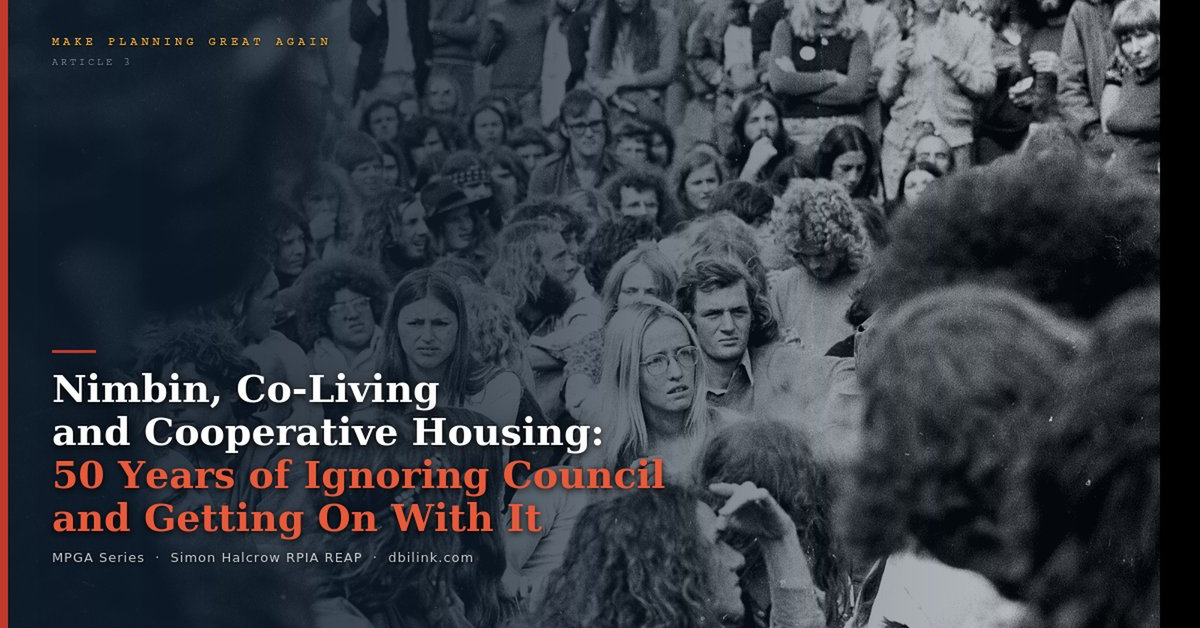
How Australia’s planning system spent fifty years failing to understand something a group of hippies solved on a hillside in 1973.
The road into Nimbin doesn’t announce itself. You leave the highway somewhere past Lismore, climb into the hinterland through cane and cattle country, and then the landscape changes. The air gets heavier. The canopy closes. You drop into a valley that feels like it belongs to a different version of New South Wales than the one that’s been arguing about housing policy for the last decade. It’s green in the particular way that subtropical rainforest country is green, which is to say aggressively, almost offensively green, the kind of green that makes you suspect the whole thing would be reclaimed in a season if you turned your back on it.
In the early 1970s, none of this was quaint. It was broke. The dairy industry that had built the Northern Rivers since the 1880s, running cream cans down the Richmond and Wilsons rivers to butter factories and coastal steamers bound for Sydney, had been quietly unravelling for years. The logs were cut out. The banana trade had gone north to Queensland, where the land was cheaper and the production economics were better. Nimbin itself was a small, tired town that the postwar economy had finished with. Shops empty. Young people leaving. The kind of place that ends up in a regional newspaper under the headline “Facing an Uncertain Future,” which is the regional newspaper way of saying it has no future at all.
Into this walked the Australian Union of Students, looking for somewhere to hold a festival.
They picked Nimbin precisely because it was discarded. The organisers of the 1973 Aquarius Festival wanted a rural community open to reinvention, somewhere that had nothing left to lose and might be interested in the proposition that there was more than one way to live. They got one. Ten thousand people arrived in May 1973 for a ten day festival that celebrated alternative thinking, sustainable living, and a general suspicion of the mainstream. The mainstream had, to be fair, recently given them Vietnam and the dismissal of Gough Whitlam’s first reform proposals, so the suspicion was not entirely without basis.
Some of them didn’t leave.
What happened next is, depending on your perspective, either the founding moment of Australia’s cooperative housing movement or the longest-running development without consent in New South Wales planning history. Possibly both.
Within weeks of the festival, a group of participants had their eye on a 486-hectare property at Tuntable Falls, the next valley east of Nimbin, below Mount Nardi. The owner was a man named Sam McKay, and the deal was struck on a verbal option for $98,000. Sam didn’t much believe in paperwork. This would later prove relevant. A cooperative structure was chosen as the ownership model, democratic, one shareholder one vote, the kind of thing that made theoretical sense to a group of people who had spent the festival workshopping alternative social arrangements. Someone went to see the Registrar of Cooperatives in Sydney to get the thing formally incorporated.
The Registrar was waiting for them. He told them he’d heard stories about the communes up north and had been wondering when someone would finally come in. This is possibly the most useful thing a NSW government official said to anyone in 1973.
The Tuntable Falls Coordination Cooperative was formally registered on 19 October 1973. Shares were $200 each. By the end of October they had raised over $50,000. By December the deeds were transferred and the cooperative took possession of the property, just weeks before one of the biggest wet seasons on record. In planning terms, what they had built was a multiple occupancy development on rural land, comprising numerous dwellings, shared services and infrastructure, communal facilities, and a cooperative ownership structure sitting entirely outside the standard residential title framework.
Today that would require a planning proposal to amend the LEP, an LEP amendment exhibition, a development application, a Statement of Environmental Effects, an engineering report, a bushfire assessment under the Planning for Bushfire Protection guidelines, a preliminary soils assessment for contamination, an ecological assessment, BDAR, a BASIX assessment for each dwelling, a s88B instrument to register the communal infrastructure obligations, and depending on the council, probably a heritage impact statement for the dairy shed they’d inevitably want to keep. It would take years. It would cost a significant amount of money. It would probably be refused at the first preliminary meeting.
In 1973 it cost $200 a share and a verbal option from a man who didn’t believe in paperwork. Which is fortunate, because the council wasn’t going to approve it anyway.
The government official in Sydney was waiting for them with open arms. It was the local end where the trouble started.
Terania Shire Council, now absorbed into what you know as Lismore City Council, though the institutional DNA runs unbroken, approved the Tuntable Falls cooperative despite the continued hostility of its shire clerk, a man named Roley Heap. I want to be careful here. Roley Heap was not a villain. He was a clerk doing what shire clerks were structurally rewarded for doing, which is finding reasons to say no to things that don’t fit the existing framework (Pre EP&A Act mind you). Novelty is risk. Precedent is safety. The professional incentive in statutory planning has always run in one direction, and it ran that way in 1973 as it runs that way today. The approval came not because of the planner but despite him, largely because the council’s health and building inspector, a man named Wally Duckering, was on their side. Wally had already ticked off the festival’s long-drop toilets, which suggests a level of pragmatism that the planning department had not yet developed.
What emerged around Nimbin in the years that followed was not a single community but a network of them. Billen Cliffs. Moondani. Blue Springs. Bodhi Farm. Siddha Farm. And further out into the Tweed hinterland, around Uki and the valley country between the border ranges and the coast, smaller clusters that shared the same cooperative land trust structure, the same general approach to shared infrastructure, and the same relationship with the planning system, which is to say, essentially none. I’ve been to a few of them. I know people who live on them. I’m not naming the Uki ones because they didn’t ask to be in a LinkedIn article, and frankly the planning system already knows roughly where they are and has made a quiet institutional decision not to look too hard. Most of them got to ten or fifteen households and stopped there. Not because they ran out of vision. Because the planning system had no pathway for them to go further, and going further meant the kind of scrutiny that tends to end in enforcement notices and a lot of expensive legal advice.
By 1994, when a community called Jindibah was established between Byron and Bangalow, there were 37 intentional communities in Byron Shire alone, with more than a hundred more in the adjoining Lismore and Kyogle shires. The planning system’s response to this, across twenty-five years, had been to treat the entire movement as technically illegal and hope it would sort itself out. It did not sort itself out. It grew.
SEPP 15, the Multiple Occupancy policy, finally provided a formal framework in 1988. Fifteen years after Tuntable Falls. The communities that had been operating since 1973 were, during the intervening period, not exactly legal. They existed in the particular NSW planning grey zone that gets described in polite company as “unresolved land use status” and in less polite company as “illegal works and uses that no-one has gotten around to prosecuting yet.” A Planning and Environment Commission circular in 1980 had tried to address multiple occupancy by administrative guidance rather than legislation, which is the planning system’s way of acknowledging that something exists without having to formally decide whether it should. SEPP 15 was eventually replaced in 1998 with the State Environmental Planning Policy for Rural Landsharing Communities. Then that framework was progressively wound back, with only three councils statewide: Lismore, Shoalhaven and Byron, exempt from the changes because they had written a multiple occupancy policy into their 2014 LEPs.
Tuntable Falls, through all of this, just kept going.
This is the part of the story I find genuinely instructive, and also genuinely funny in the way that only planning history can be funny, which is the humour of watching the same bureaucratic wheel reinvented every decade and presented as innovation. Since 1973, the NSW and Australian planning and housing systems have produced, in roughly chronological order: the boarding house SEPP, the affordable rental housing SEPP, the seniors and people with a disability SEPP, the social housing SEPP, the co-living housing policy, the build-to-rent framework, the shared equity scheme, the Housing Accord, the National Housing Supply and Affordability Council, and approximately forty ministerial press releases announcing that collaborative and affordable housing models are the future. Each one arrives with a glossy acronym and a framing document. Each one rediscovers, in slightly different language, that people living collectively on shared land with shared infrastructure and non-speculative ownership structures can access housing that the individual freehold market cannot deliver.
Tuntable Falls has been doing this since 1973. Nobody held a press conference.
The reason cooperative housing keeps getting rediscovered rather than scaled is not that the model doesn’t work. It is demonstrably working. The reason is three overlapping structural failures that the planning system has never seriously addressed. The first is finance. A cooperative share doesn’t give a lender clean security the way a freehold title does, which means mainstream mortgage products don’t work, which means access is restricted to people who can self-fund or pool resources without borrowing. The second is the planning pathway. There is no standard, replicable route from “we want to form a community on rural land” to “we have lawful approval to occupy it,” without a bespoke legal trust structure, a customised planning application, and a consultant who has done it before. Which brings me, not entirely accidentally, to a third point.
The instinctive hostility. Roley Heap in 1973 was not an anomaly. He was a preview. The structural logic of the statutory planning role rewards caution, penalises approval, and produces, reliably, an officer whose default response to a novel housing model is to find the policy gap and park the application in it. I say this not as a criticism of any individual but as a description of a system that trains people to behave this way by making approval the source of all risk and refusal the path of least consequence. We saw a version of this in the comments on Articles 1 & 2 of this series. A council planner, faced with a practical legislative argument for reform, responded not with engagement but with institutional defence. It was not aggressive. It was something more dispiriting than aggression. It was the mild, professional certainty of someone who has never been required to ask whether the framework itself is the problem. Roley Heap, fifty years later, in a LinkedIn comment box. The archetype is alive and it has a profile photo.
This has to change. The culture that produced Roley Heap in 1973 is not a relic. It is the default setting. Walk into a pre-lodgement meeting at the majority of NSW councils today and you will find it waiting for you. Not aggression. Something quieter and more entrenched than aggression. An institutional disposition toward no that has been reinforced by fifty years of a system that punishes approval and rewards caution. The good councils exist. They are the minority and everyone in the industry knows who they are, because they stand out precisely because they are exceptions.
The housing crisis is not a shortage of policy. It is a shortage of approvals, and the culture that produces that shortage runs deeper than any individual officer. It is baked into the incentive structure of the role itself. ‘No’ carries no consequences. Yes carries all of them. Until that changes, every cooperative housing model, every co-living proposal, every novel tenure arrangement that doesn’t fit the existing checklist will meet the same face at the counter that Tuntable Falls met in 1973. The reform is not another SEPP. It is accountability for outcomes, not just process. It is a planning system that rewards yes as readily as it currently rewards no.
Tuntable Falls is still there. More than fifty years of shared land, shared infrastructure, and cooperative ownership on a hillside in the Northern Rivers. It has survived government resistance, drug raids, internal conflict, floods, and the persistent indifference of a planning system that spent a quarter century pretending it didn’t exist. The valley is still green. The cooperative is still registered. The shares are still the best value housing in the region.
It didn’t need a ministerial press conference. It needed a hillside, a man who didn’t believe in paperwork, and two hundred dollars.
This is Article 3 in the MPGA (Make Planning Great Again) series. Article 1: Delete the Council DA Planner. Article 2: The Registered Planner Certified Assessment Model.
Simon Halcrow is a Registered Planner and Registered Environmental Assessment Practitioner and Development Manager at Design Build Instruct Pty Ltd (DBI). He works across Development Applications, Planning Proposals, State Significant Development and State Significant Infrastructure in NSW. visit www.dbilink.com
References
1. McGee, T. (2013). “Making the Aquarius Dream a Communal Reality.” The Echo.https://www.echo.net.au/2013/05/making-the-aquarius-dream-a-communal-reality/
2. Tuntable Falls Co-ordination Co-operative. “Tuntable’s Housing History.” coco.org.au.https://coco.org.au/history/tuntables-housing-history/
3. Tuntable Falls Co-ordination Co-operative. “History of the Tuntable Falls Community.” coco.org.au.https://coco.org.au/history/history-of-the-tuntable-falls-community/
4. Wikipedia. “Aquarius Festival.” https://en.wikipedia.org/wiki/Aquarius_Festival
5. Wikipedia. “Rural Landsharing Communities.” https://en.wikipedia.org/wiki/Rural_Landsharing_Communities
6. NSW Revenue. Land Tax Ruling LT010 – Multiple Occupancy of Rural Land. revenue.nsw.gov.au.https://www.revenue.nsw.gov.au/help-centre/resources-library/rulings/land/lt010
7. The Echo. (2015). “Multiple Occupancy Zonings Being Abolished by Stealth.” echo.net.au.https://www.echo.net.au/2015/09/multiple-occupancy-zonings-being-abolished-by-stealth/
8. Champagne, W. (2025). “Finding Utopia: Australia’s Intentional Communities.” Australian Geographic, 17 February 2025. https://www.australiangeographic.com.au/history-culture/2025/02/finding-utopia-australias-intentional-communities/
9. Northern Rivers Intentional Communities. “Who We Are.” nric.com.au. https://www.nric.com.au/who-are-we via wayback machine https://web.archive.org
10. Visit Lismore. “Nimbin: History and Heritage.” visitlismore.com.au. https://www.visitlismore.com.au/the-region/nimbin/about-nimbin/history-heritage/